The short answer: freelancers and local professionals get clients where people ask for recommendations: business owners' groups for business services, community groups for everything local. Post one clear service with a real example and a starting price on each group's promotion day, and answer requests with useful advice before your offer. It works when you're in front of those groups every week, which by hand eats the hours you'd bill; AutoGP posts it for you.
For coaches, see our guide for coaches. For other kinds of business, see all our business guides.
Where clients look for a professional
- Business owners' groups:
[city] small business owners,[city] entrepreneurs,[country] small business network, often with a weekly promotion thread. - Platform and industry groups:
Shopify store owners,Etsy sellers,[industry] owners, where people ask for designers, bookkeepers and developers. - Community groups:
[town] community,[town] recommendations,[town] moms, for repair, pets, insurance and tax help. - Newcomers:
new to [town],expats in [city], people who need a new tax preparer, insurance or groomer right now. - Interest groups:
[city] dog owners,[breed] owners [region],[city] travel lovers.
The strongest post here is a helpful one. Answering "how do I…?" well, then offering your service, earns more trust than a list of what you do.
The one-service post
One offer per post, not your whole menu:
{Need|Looking for} [the result]? I {do|offer} [one service] for [who].
{Recent example|Recent job}: [one line about a real project, shared with permission]
{From|Starting at} [price] · [turnaround] · [area or online]
{Message me|Send me a message} {for a quote|to book}.
Change the service from week to week so a group never sees the same offer twice in a row.
How to get clients as a graphic or web designer
- Search Facebook for:
[city] small business owners,[city] entrepreneurs,Shopify store owners,[industry] business owners,startup founders [country]. - What works: one real project per post, the client's problem, what you made, and a fixed-price starter service. Mockups are fine if you call them concepts.
- Rhythm: a weekly promotion-day post; answer design questions in between.
- Calendar: January (new plans), spring (new sites before summer), and before the holiday season for shops.
How insurance agents find clients
- Search Facebook for:
[town] community,new to [town],[town] moms,[city] small business owners,[city] homeowners. - What works: explain one thing people get wrong (renters' cover, business liability, what changes when you move), then offer a quote. Name the lines you're licensed for and the states.
- Many groups ban insurance posts. Read the rules and stick to groups that allow them.
- Calendar: open enrollment periods, moving season, and new-business season in January.
How tax preparers and bookkeepers get more clients
- Search Facebook for:
[city] small business owners,[town] community,[city] freelancers,new to [country],Etsy sellers. - What works: the returns or books you handle (freelancers, small businesses, rentals), your credentials (PTIN, EA, CPA, or your country's equivalent), how it works remotely, and your fee from. Deadlines make posts timely.
- Bookkeeping is all year: a monthly package for small businesses and sellers fills the months after tax season.
- Calendar: January to the filing deadline for returns; quarterly estimated-tax dates; year-end for bookkeeping clean-ups.
{Tax season|Filing season} is {here|open}: [type of return] {prepared|filed} from [price]
[Credential] · {remote or in person|online or at my office} in [area]
{Book|Grab} a slot before [deadline]: {message me|send me a message}.
How travel agents get more bookings
- Search Facebook for:
[city] brides(honeymoons),[town] moms(family trips),[city] travel lovers,[destination] travel [country],[city] retirees. - What works: one trip idea with dates, what's included and a price from, plus what you handle that a website doesn't. Group trips and honeymoons suit groups.
- Registration: some US states, such as California and Florida, require sellers of travel to register, and California wants the number in ads.
- Calendar: January for summer, late summer for the holidays, and wedding season for honeymoons.
How phone and computer repair shops get more customers
- Search Facebook for:
[town] community,[town] buy sell trade,[college] students,[town] moms,[city] small business owners. - What works: the common repairs with a price from, turnaround, warranty and walk-in hours. Students and parents respond to "back to school" repair and set-up posts.
- Brand names: use them to describe what you fix, and say "independent" unless you're authorized.
- Calendar: back to school, after the holidays (new-gadget accidents), and spring.
How pet groomers and dog trainers get more clients
- Search Facebook for:
[city] dog owners,[town] pets,[breed] owners [region],[town] moms,new to [town]. - What works: groomers post real before-and-after photos with the owner's permission, sizes and prices, and open appointments; trainers post a short clip, the problems they help with (pulling, recall, puppies), class times and prices.
- Honesty: trainers describe their methods and don't promise results; groomers say how they handle anxious dogs.
- Calendar: spring shedding and summer cuts, the holidays for grooming; new-puppy season and New Year for training.
The rules for professionals
- Licenses and credentials. Insurance agents are licensed by state; paid US tax preparers need a PTIN; some travel sellers must register. Name only credentials you hold.
- No promises. Not a refund amount, not savings you can't show, not a trained dog in a set number of days.
- Client work and data. Show a client's project only with their permission, and never their personal or financial details.
- Trademarks. Don't use brands' logos in a way that suggests you're their partner.
- Advertising law. Claims must be true. The FTC's advertising guide for small businesses applies online too, and Meta's Commerce Policies keep services off Marketplace.
This is general information, not legal advice.
Doing it with AutoGP, step by step
AutoGP is a Chrome extension paired with your autogp.ai account. It makes ordinary posts in the groups you've joined, as the Facebook profile logged into Chrome, and never asks for your Facebook password. Chrome stays open while it posts. AutoGP isn't affiliated with Meta.
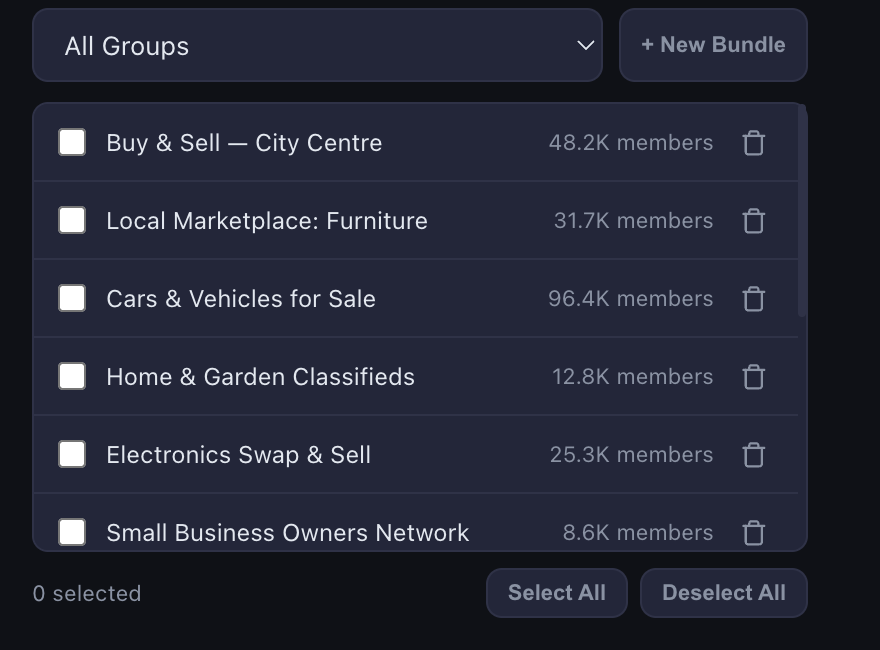
Sync your groups in the Groups tab and bundle them by promotion day and audience: "Business groups (Monday promo)", "Community groups", "Dog owners".
Write one post per service with spintax, attach a real example, and save each as a template. Put your portfolio or booking link in First Comment where links are allowed.
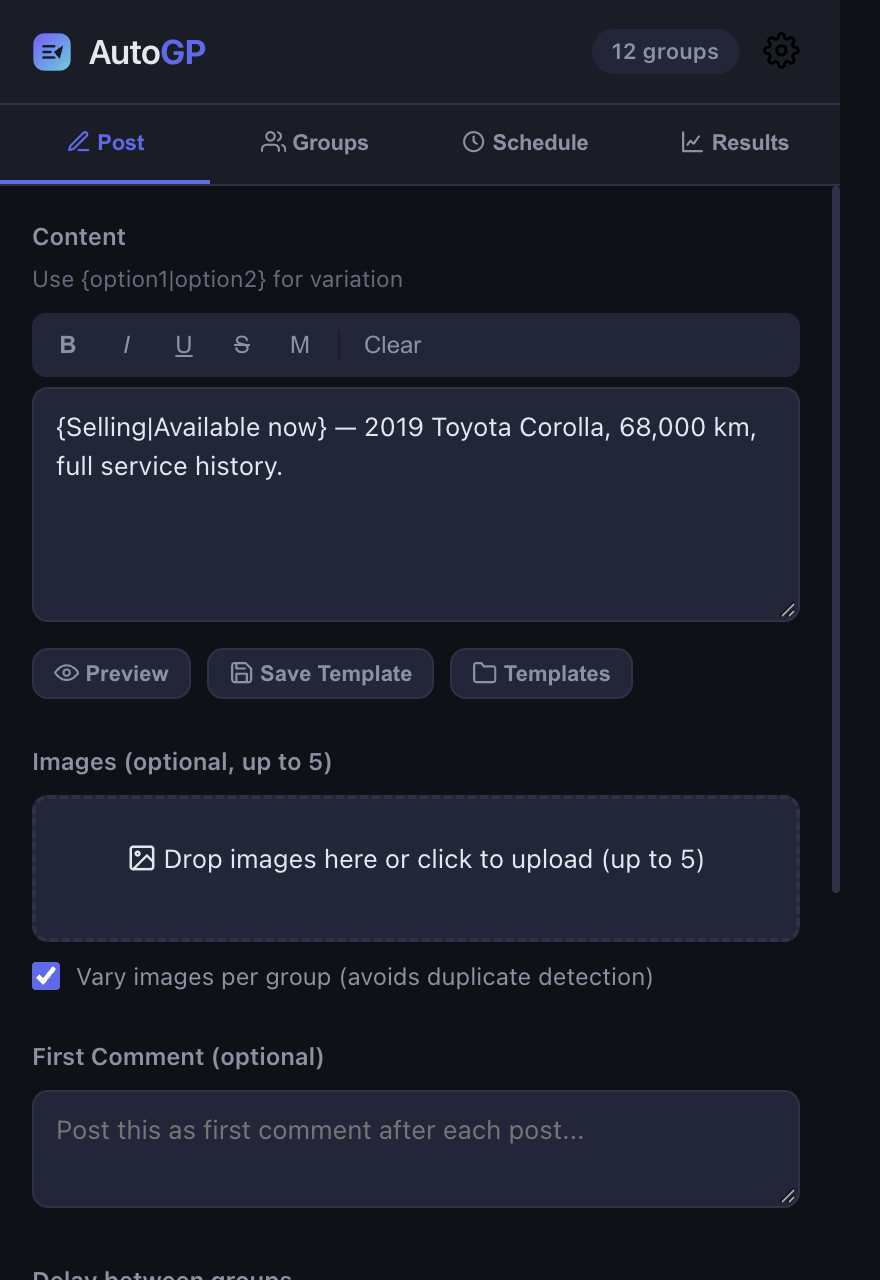
Preview the versions and check prices and credentials.
Schedule a different service each week on each group's promotion day, and repeat the seasonal ones.
Check Results for where each post went up, and answer questions in the comments.
Protection is on by default: a warm-up daily limit set by your account's age, random delays, and a guard against near-identical posts. After 19 free posts (no card), see pricing. Any posting tool carries some risk to your Facebook account, which our terms explain.
What not to do
- Your whole menu in one post. One service, one example, one price.
- Other people's portfolios or client work without permission.
- Credentials you don't hold, or "authorized" when you aren't.
- Promises of refunds, savings or results.
- Insurance or tax posts in groups that ban them.
- The same post in every group every day. Once a week per group is plenty; see posting limits.