The short answer: Facebook group marketing for coaches works when you become the most useful person in the groups your ideal clients already read. Post teaching content most of the time, end posts with a question rather than a pitch, reply to every comment, and mention your offer only where each group's rules allow it. A steady weekly rhythm in 10 to 20 well-chosen groups, plus eventually a group of your own, does more than a burst of sales posts in a hundred.
Coaching is sold on trust. Nobody books a call with a stranger who dropped a link into their feed, but plenty of people book with the person whose advice they've been reading for a month. Facebook groups are one of the few places where you can build that trust in public, in front of people who have already gathered around the exact problem you solve.
This guide covers how to do it without burning your reputation or your account: which groups to pick, what to post, how to handle comments, and a weekly plan you can actually keep up.
Selling a local service or product rather than coaching? Our business guides cover the groups and posts for each kind of business.
Why groups still work for coaches
Your own Facebook profile or Page mostly reaches people who already know you. A group reaches people who joined because they care about a topic: new managers, first-time runners, parents of toddlers who won't sleep, freelancers trying to raise their rates. That's a pre-sorted audience, and many of them are actively asking questions.
Groups also reward the thing coaches are good at: explaining. A clear, specific answer to a member's problem is useful to everyone who reads it, and it shows how you think far better than a sales page does.
The catch is that group members and admins have seen every kind of self-promotion. They can spot a post that exists only to funnel people into a DM, and many groups have rules written specifically to keep coaches from doing that. So the approach has to be different from advertising.
Which groups to join
The most common mistake is joining groups full of other coaches. Those are fine for peer support, but your clients aren't there. Look for groups organized around your client's problem or identity, not around coaching.
Some examples:
- A career coach looks for groups for job seekers in a specific field, new managers, or people changing careers after 40.
- A fitness or nutrition coach looks for groups about beginner running, strength training for women over 50, or a specific diet people are trying.
- A business coach looks for groups for Etsy sellers, bookkeepers going solo, or local small-business owners.
- A relationship or parenting coach looks for groups for new parents, blended families, or people rebuilding after a divorce.
Before you commit to a group, check four things:
- The members match your client. Read the last few weeks of posts. Are these the people you'd want on a call?
- It's active. Recent posts with real comments, not a wall of unanswered ads.
- The rules allow what you want to do. Some groups ban all promotion, some allow it on one day a week, some allow a link only in the comments. Write the rule down.
- Admins actually moderate. A group with no moderation fills up with spam, and your useful posts get lost in it.
Ten to twenty good groups is plenty to start with.
Running your own group
Other people's groups are where you're discovered. Your own group is where people get to know you. Once you have a steady trickle of people asking follow-up questions, a free group gives them somewhere to go that isn't a sales call.
Keep it narrow and named for the outcome, not for you: "Confident First-Time Managers" says more than "Jane's Coaching Community." Post there on a schedule, answer questions, run the occasional live Q&A, and make your paid offer visible without making every post about it. As its admin you can also schedule posts natively inside it.
Don't use your group as a reason to spam invitations into other groups. A single mention in your profile and an occasional "I run a free group on this if you want more" where rules allow is enough.
What value-first posting looks like
A useful rule of thumb is that most of your posts should be worth reading even if the reader never buys anything. That isn't a Facebook rule, just a way of keeping yourself honest.
Value posts that work well for coaches:
- A mini-lesson. One specific idea, explained in a few short paragraphs. "The 3 questions I ask before a salary negotiation" beats "Know your worth!"
- A before-and-after, anonymized. What a client was stuck on, what changed, and the one shift that made the difference. Never share details a client could be recognized by, and get permission first.
- A myth you disagree with. Coaches have opinions. A calm, reasoned "here's why I don't recommend X" gets people talking.
- A checklist or template, typed out in full. Put the value in the post itself instead of behind an opt-in.
- A question to the group. "What's the hardest part of your morning routine right now?" teaches you what people struggle with and gives you material for the next ten posts.
End most posts with a genuine question. You want replies, and you want to learn from them.
Why sales-only posts backfire
A post that's only a pitch ("DM me to book your free discovery call!") tends to fail three ways at once.
First, admins remove it, and a coach who keeps posting pitches in a no-promotion group gets removed too. Second, members scroll past or report it, and reports matter: they are one of the signals Facebook's systems look at. Third, if the same pitch goes out word for word to many groups in a short window, that's the repetitive posting Meta's spam policy names as a sign of spam, which can lead to restrictions on your whole account rather than a single group. Can you advertise in Facebook groups? goes through where promotion is and isn't acceptable.
When you do promote, and you should sometimes, do it inside the rules and make the post useful on its own. "I'm opening four coaching spots in October for new managers. Here's who it's for and who it isn't for, and here's the one thing I'd tell you even if you never work with me" respects the reader. Put a link in the first comment if the group prefers that.
Turning comments into conversations
Comments are where group marketing actually happens. A post with no replies taught a few people something. A post with a real back-and-forth shows you coaching in public.
- Reply to every comment, quickly and specifically. "Great point!" adds nothing. "That's really common in the first 90 days. Which part is harder, the one-to-ones or the team meetings?" moves the conversation forward.
- Answer in public first. Other members read the thread, and a good public answer is worth more than a private message.
- Move to messages only when invited. If someone asks for more help, "Happy to share the template I use, want me to message you?" is fine. Sliding into the inbox of everyone who liked a post is not, and it's a fast way to get reported.
- Skip engagement bait. Posts that demand "comment YES and I'll send it" are banned in many groups, and Facebook has said for years that it demotes posts that goad people into reacting or commenting. Ask a real question instead.
- Keep notes. When the same question shows up three times, that's your next post, and possibly your next offer.
A weekly rhythm you can keep
Consistency matters more than volume. This is a sample week for a coach active in about 15 groups plus their own:
| Day | Other people's groups | Your own group |
|---|---|---|
| Monday | Post one mini-lesson across your core groups, worded differently in each | Weekly check-in question |
| Tuesday | 20 minutes answering other members' questions, no posting | Reply to comments |
| Wednesday | Post a question or myth-busting post in a different set of groups | Short tip or template |
| Thursday | 20 minutes of replies, follow up on conversations from Monday | Live Q&A or a longer lesson |
| Friday | Promotional post, only in groups whose rules allow it that day | Wins thread: members share progress |
| Weekend | Light replies only | Rest, or a scheduled reflection prompt |
The replies are not optional. Answering other people's questions without posting anything of your own is how members start recognizing your name, and it's how admins learn you're a contributor rather than a marketer.
Where AutoGP fits
The slow part of this plan isn't writing the Monday lesson. It's opening 15 groups one by one, pasting it, rewording it so each group doesn't get an identical copy, attaching the image and pressing Post, every week.
AutoGP is a Chrome extension that does that posting for you, in the groups you've already joined, from your own logged-in browser. It never asks for your Facebook password. You write the post once in the Post tab, use spintax to vary the wording from group to group, check sample versions with Preview, and add a first comment if a group prefers links there.
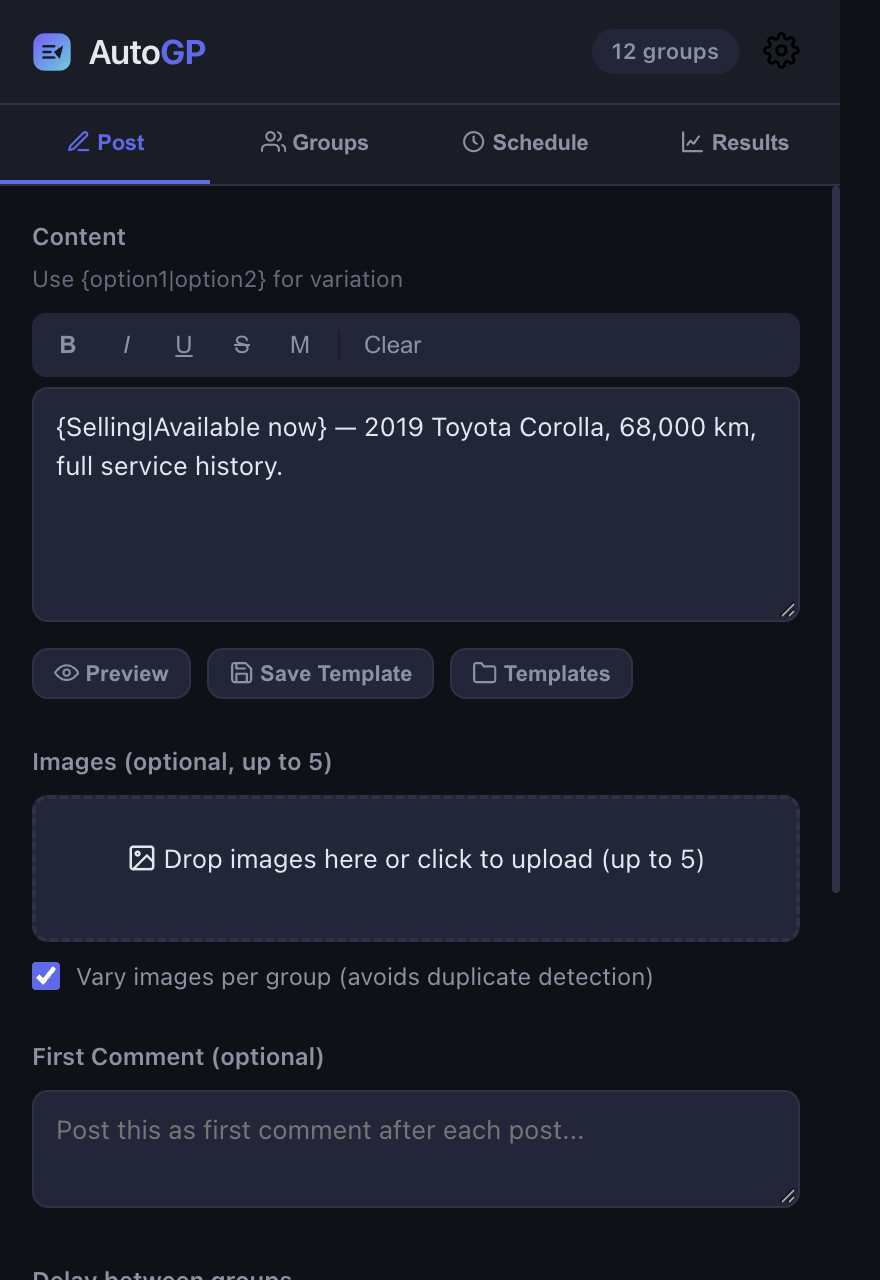
Save your core groups as a bundle, pick it, and press Start Posting. AutoGP opens each group in a small window in the corner of your screen, types the post into Facebook's own composer and checks it went through, with a random wait between groups and a daily limit set from your account's age. Chrome has to stay open while it runs. The Schedule tab lets you set the Monday lesson for a date and time, as long as Chrome is open then, and Save Template keeps a recurring post like your wins-thread invitation.
It handles the posting, not the relationship. Replying to comments, reading each group's rules and choosing which groups get the promotional post are still your job, and they're the part that brings clients. Posting to many groups can also conflict with Facebook's rules, and no tool removes that risk, as the Facebook account risk section of our terms explains; Facebook group posting limits covers sensible volumes. AutoGP starts with 19 free posts, and plans are on the pricing page. For more on the strategy side, browse the group marketing topic.
Frequently asked questions
How many Facebook groups should a coach be in?
Enough to reach your clients, few enough to actually take part. Ten to twenty active, well-moderated groups is a good start. Being in hundreds of groups you never read doesn't help, and posting in all of them every day would look like spam.
Should coaches post their offer in Facebook groups?
Sometimes, and only where the rules allow it. Many groups have a promotion day or a pinned thread for offers. Keep most of your posts purely useful, and make any promotional post clear about who it's for.
Is it better to start my own Facebook group or post in others?
Both, in that order. Other people's groups are where new people find you. Your own group gives the people who want more somewhere to go. Starting your own group with no audience usually means talking to an empty room.