The short answer: Facebook group marketing for network marketers works only when you post less and say more. Recruiting pitches pasted into dozens of groups get removed by admins, reported by members and look like spam to Facebook, and many groups ban MLM posts outright. Pick groups whose rules allow what you do, post mostly useful content about the product or the lifestyle rather than the opportunity, avoid income claims, and keep your volume at a pace your account can carry.
Network marketing has a reputation problem in Facebook groups, and most of it comes from a small number of habits: the copy-pasted "Who wants to earn from home?" post, the unsolicited message to everyone who comments, the screenshot of a commission check. Group members have seen all of it, and many admins now write rules specifically to keep it out.
That doesn't mean groups are closed to you. It means the approach that worked years ago now costs more than it brings in: removed posts, banned memberships, a restricted account and a reputation that follows your name. This guide covers what's actually happening and a way of posting that holds up.
If you also run a local business, such as baking, beauty or cleaning, our business guides cover the groups and posts for it.
The pressure on high-volume recruiting posts
Three separate things push back when you post the same recruiting message to a lot of groups.
Admins. Each group has its own rules, and admins can remove posts, decline them automatically with Admin Assist, require approval for every member post, or remove members. A recruiting post in a group that bans them usually gets you removed, not warned.
Members. People who joined a group about gardening or budgeting didn't join to be recruited. They report posts, and reports are one of the signals Facebook's systems look at. A member who feels pitched also remembers your name, and in local groups that can reach your friends and family.
Facebook itself. Meta's spam policy prohibits posting at very high frequency, whether by hand or automatically, and it names repetitive content as a sign of spam that can justify restrictions even at lower volumes. The same recruiting post sent word for word to 60 groups in an hour is close to the textbook example. The result can be a temporary block on posting in groups, or longer restrictions that affect your whole account, including the groups where you were doing everything right. How to avoid Facebook jail covers what those restrictions look like and how to recover.
These add up. An account that's been restricted a few times posts to fewer groups, gets more of its posts held for approval, and has less room for error the next time.
Group rules against MLM posts
Read the rules before you post anything, every time you join a new group. "No MLM," "No direct sales," "No business opportunities" and "No recruiting" are common rules in local community groups, parenting groups, buy-and-sell groups and hobby groups. Some groups allow product posts but not recruiting, some allow either on a single promotion day, and some allow nothing commercial at all.
A simple way to keep track:
- Green groups explicitly allow direct sales or business posts, sometimes on a set day. Post there, within the rules.
- Yellow groups allow product recommendations or a weekly promotion thread, but not recruiting. Share products the way a customer would, never the opportunity.
- Red groups ban MLM or all promotion. Take part as a regular member, or leave. Don't post around the rule with vague "DM me for details" teasers, because admins recognize those too.
If a group puts your post in pending, that's the group's approval setting, not a problem with your account. Reposting won't speed it up. Why can't I post in Facebook groups explains the other reasons a group can refuse a post, and can you advertise in Facebook groups covers promotion rules more broadly.
Be careful with income claims
This is the part network marketers most often get wrong, and it isn't only a Facebook issue.
In the US, the Federal Trade Commission treats statements about what people can earn as advertising claims. It has published business guidance for multi-level marketing that warns against income claims that aren't typical of what most participants actually earn, and against lifestyle claims (the car, the vacation, "fire your boss") that imply the same thing without a number. Health claims about products are a separate area it also watches. Other countries have their own rules on advertising and business-opportunity claims.
Most direct-sales companies also have their own policies on what distributors may say about income and products on social media, and those can be stricter than the law.
This article isn't legal advice, and the rules depend on where you are and what you sell. The practical takeaways are general:
- Don't post your own income, commission screenshots or rank-bonus payouts as a recruiting hook.
- Don't imply that joining will replace a job, pay off debt or buy a lifestyle.
- Don't make health or medical claims about products beyond what your company has approved.
- Read your company's income disclosure statement and its social media policy, and follow them.
- If in doubt, talk about the product experience, not the money.
A safe posting pace
Even compliant, useful posts can get an account restricted if too many go out too fast. Facebook doesn't publish a posting limit, so any number is a guideline, not a guarantee. As a rough guide from our article on Facebook group posting limits:
- A newer account should start around 25 posts a day, spaced minutes apart across the day, and build up gradually over weeks.
- An account more than two years old with regular, normal activity can typically sustain more, up to about 90 to 100 a day.
- Raise volume by no more than about 30% a week, and if you see a warning sign (a temporary block, posts suddenly held for approval in groups that never held them, removals you can't explain), stop, wait it out fully, and restart lower.
For most network marketers, those numbers are far more than you need. Twenty groups whose rules actually allow your post will do more than 100 groups where it gets removed. Vary the wording in each group, too: spintax lets you write one post with alternative phrasings so each group gets a different version.
Content that isn't a pitch
The network marketers who do well in groups tend to post like customers and community members first. Some formats that work:
- Honest product use. "Three ways I actually use this in my morning routine, and one thing it didn't help with." Balanced posts get trusted.
- How-to content around the product's category. A skincare distributor writes about building a simple routine for dry winter skin. A kitchen-products seller shares a 20-minute weeknight recipe. The product can appear without being the point.
- Answers to other members' questions. Spend more time replying than posting. Genuine answers, with no link and no "DM me," are how people come to trust your name.
- Behind-the-scenes of your day, in groups where that fits: packing orders, a local pop-up, a class you're running.
- Events. A free workshop, a sample night, a community fundraiser, posted in local groups that allow events.
- Questions to the group. "What's the one product you keep rebuying?" starts a conversation without any selling.
When someone is interested, they'll ask. Answer in the comments first, then move to messages only when they want more. Messaging everyone who liked a post is the fastest way to get reported.
If you want a place to talk about the opportunity, run your own group for customers and interested people, where you set the rules and people join knowing what it's about. Invite people to it; don't drag the conversation into other people's groups.
A realistic weekly routine
- Most days: 15 to 20 minutes answering questions in groups you belong to, no posting.
- Two or three times a week: a useful, non-promotional post in the groups where it fits, worded differently in each.
- On each group's promotion day: one product post, within that group's rules, with no income claims.
- Once a week: review which groups removed or held posts, and drop the groups where your posts don't belong.
Where AutoGP fits
If you post the same useful content to a list of groups each week, most of the time goes on opening each group, pasting, rewording and attaching images. AutoGP is a Chrome extension that does that part from your own logged-in browser, in groups you've already joined, without ever asking for your Facebook password.
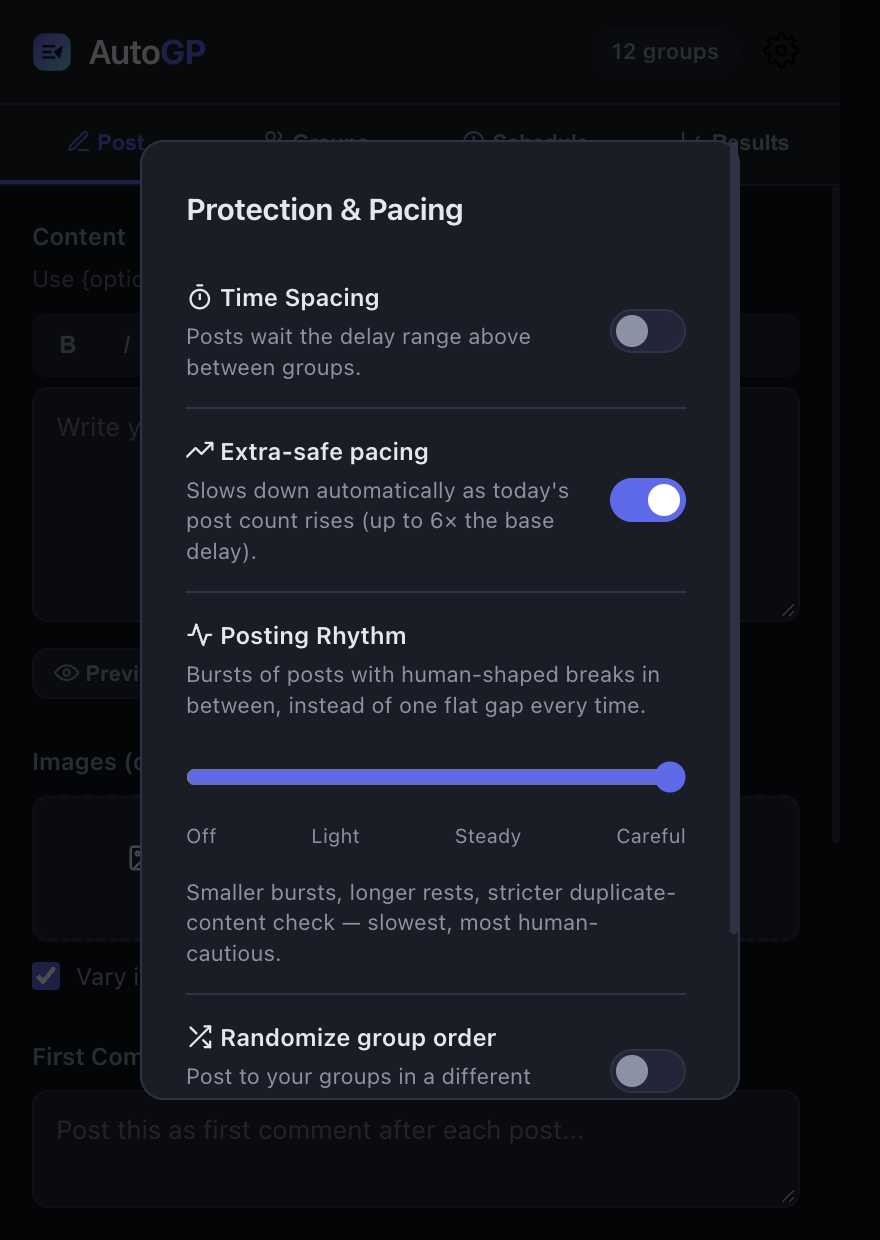
You write once, vary the wording with spintax, save your green groups as a bundle and press Start Posting. AutoGP posts to one group at a time with random waits between them, and it sets a daily limit from your account's age, starting at 25 a day for a new account and rising about 30% a week toward a ceiling. The waits stretch as the day's count climbs, it only posts between 08:00 and 23:00 by default, and it warns you when a post is very similar to one you sent in the last 24 hours. If Facebook signals a block on the account, it stops the whole run.
What it won't do is decide what's appropriate to post. Choosing groups whose rules allow your content, keeping income and health claims out of your posts and following your company's policy are on you. Posting to many groups can conflict with Facebook's rules, and no tool removes that risk; the Facebook account risk section of our terms spells it out. AutoGP starts with 19 free posts, and plans are on the pricing page. For more guides on this, browse the group marketing topic.
Frequently asked questions
Is MLM allowed in Facebook groups?
It depends on the group. Facebook doesn't ban direct sales, but each group sets its own rules, and many ban MLM or recruiting posts. Read the rules of each group and post only where your content is allowed.
Why do my network marketing posts keep getting removed?
Usually because the group's rules don't allow them, members reported them, or an admin's automatic filters declined them. Posting the same text to many groups quickly can also lead Facebook to restrict your account. Check each group's rules and vary your posts.
Can I share my income on Facebook to recruit?
It's risky. In the US, the FTC has warned against earnings claims that aren't typical of what most participants make, and most companies restrict what distributors can say. This isn't legal advice, but the safe habit is to leave income out of recruiting posts.
How many groups should a network marketer post in per day?
Fewer than you think. A newer account should stay around 25 posts a day spread across the day, and even older accounts should build up gradually. What matters more is posting only in groups whose rules allow your content.