The short answer: families choose tutors, teachers and childcare from what other parents recommend, and most of that happens in parents' groups on Facebook. Post your subjects or ages, your qualifications, where and when you teach, the price and the places you have left, in school parents', moms' and dads', homeschool and community groups, a few weeks before each term. Parents trust what they see repeatedly, so a steady post beats a single one; AutoGP posts it to all those groups for you and repeats it until the places fill.
For one-off workshops and events, see our guide for events and classes. For other kinds of business, see all our business guides.
Where families look for teachers and care
- School parents' groups:
[school] parents,[school] PTA,[school] class of [year] parents. - Local parents' groups:
[town] moms,[town] dads,[town] parents,[town] kids activities. - Homeschool groups:
[state] homeschool,[town] homeschool co-op, where parents hire tutors and teachers for single subjects. - Newcomers:
new to [town],[base] spouses,[employer] families, relocation groups. - Students themselves:
[college] students,[college] class of [year]for exam tutoring and adult learners.
Parents are careful here, as they should be. A clear name, real qualifications and a plain description of how lessons work do better than a slick ad.
The places-left post
One post that works across this page, before every term:
{Places open|Spaces available|Now enrolling} for [term]: [subject or age group]
[Where or online] · [days and times] · [price per lesson or month]
[Your qualification or license, in one line]
{Message me|Send me a message} to {book a trial|arrange a visit}.
Say how many places are left only if the number is true, and update it as they fill.
How to get more tutoring students
- Search Facebook for:
[school] parents,[town] moms,[state] homeschool,[town] SAT prep,[college] students,11 plus [town]in the UK. - What works: the subjects and grades, the exams you prepare for, your background (teacher, graduate, native speaker), in person or online, the hourly rate and the free times this week. A small group rate helps families on a budget.
- Rhythm: weekly during term, with an extra post a month before exams.
- Yearly calendar: late August and September, January, before mock exams and finals, summer catch-up.
How music and art teachers find students
- Search Facebook for:
[town] moms,[town] kids activities,[state] homeschool,[town] community,[city] adult learners. - What works: instruments or media, ages and levels, where lessons happen, the price per lesson, a trial lesson, and a short clip or photo of students' work shared with permission. Mention recitals or exhibitions: parents like a goal.
- Adults count too: "never too late" beginners' groups fill evening slots.
- Rhythm: weekly at term starts, every two weeks otherwise.
- Calendar: September, January, summer workshops posted from February, holiday gift lessons in December.
{[Instrument] lessons|Learn [instrument]|[Instrument] for beginners} for [ages] in [area]
{Trial lesson|First lesson} [price or free], then [price] a lesson
{Openings|Free slots}: [days and times]
{Message me|Send me a message} to book · recital in [month]
How daycares and childcare providers find families
- Search Facebook for:
[town] moms,[town] parents,new to [town],[employer] families,[town] pregnancy(parents plan care early). - What works: openings by age group with the start date, hours, the area (not your full address in a public group), meals and activities included, the price, and your license number where your state asks for it. Photos of the empty space, not of children.
- Safety first: say what checks staff have passed, ratios, and how parents can visit.
- Rhythm: a post when places open, repeated weekly until they fill.
- Calendar: late summer for September, January, and before parents' leave ends.
How driving schools get more students
- Search Facebook for:
[high school] parents,[town] moms,[college] students,new to [town],[city] expats(for licence conversions). - What works: lesson packages and prices, the car (manual or automatic), pick-up areas, test preparation, and your school's license. Weekend and evening slots matter to working adults.
- Rhythm: weekly, with extra posts at school holidays.
- Calendar: summer holidays, spring break, and students' birthdays when learner permits start.
The rules for teachers and childcare
- Children's photos and details. Only with a parent's written permission, and never with names, schools or locations that identify a child.
- Licensing. Childcare in most US states needs a license beyond a small number of children, and some states want the license number in ads. Driving schools and instructors are licensed by the state.
- Background checks. Say you've passed them only if you have, and name which.
- Claims. Pass rates, grade improvements and "certified teacher" must be true and provable. The FTC's advertising guide for small businesses applies online too.
- Group rules. School and PTA groups often ban business posts or allow them only from parents of the school. Follow them.
This is general information, not legal advice.
Doing it with AutoGP, step by step
AutoGP is a Chrome extension paired with your autogp.ai account. It shares ordinary posts in groups you've joined, as the Facebook profile logged into Chrome, and never asks for your Facebook password. Chrome stays open while it posts. AutoGP isn't affiliated with Meta.
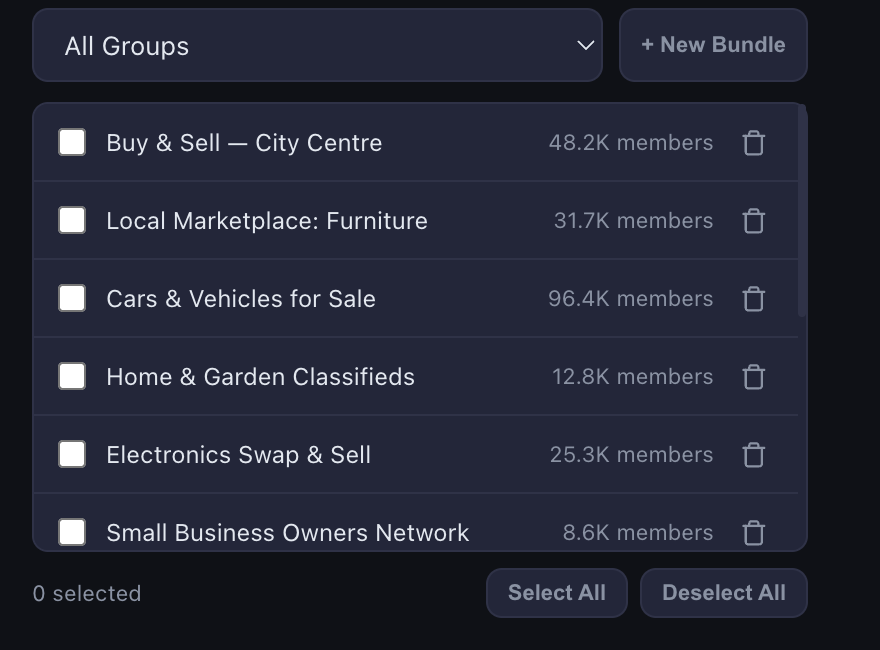
Sync your groups in the Groups tab and bundle them by audience and area: "School parents' groups", "Homeschool groups", "New to town".
Write the places-left post with spintax and attach photos of your space or students' work (with permission), varied slightly for each group. Put your enrolment form in First Comment where links are allowed.
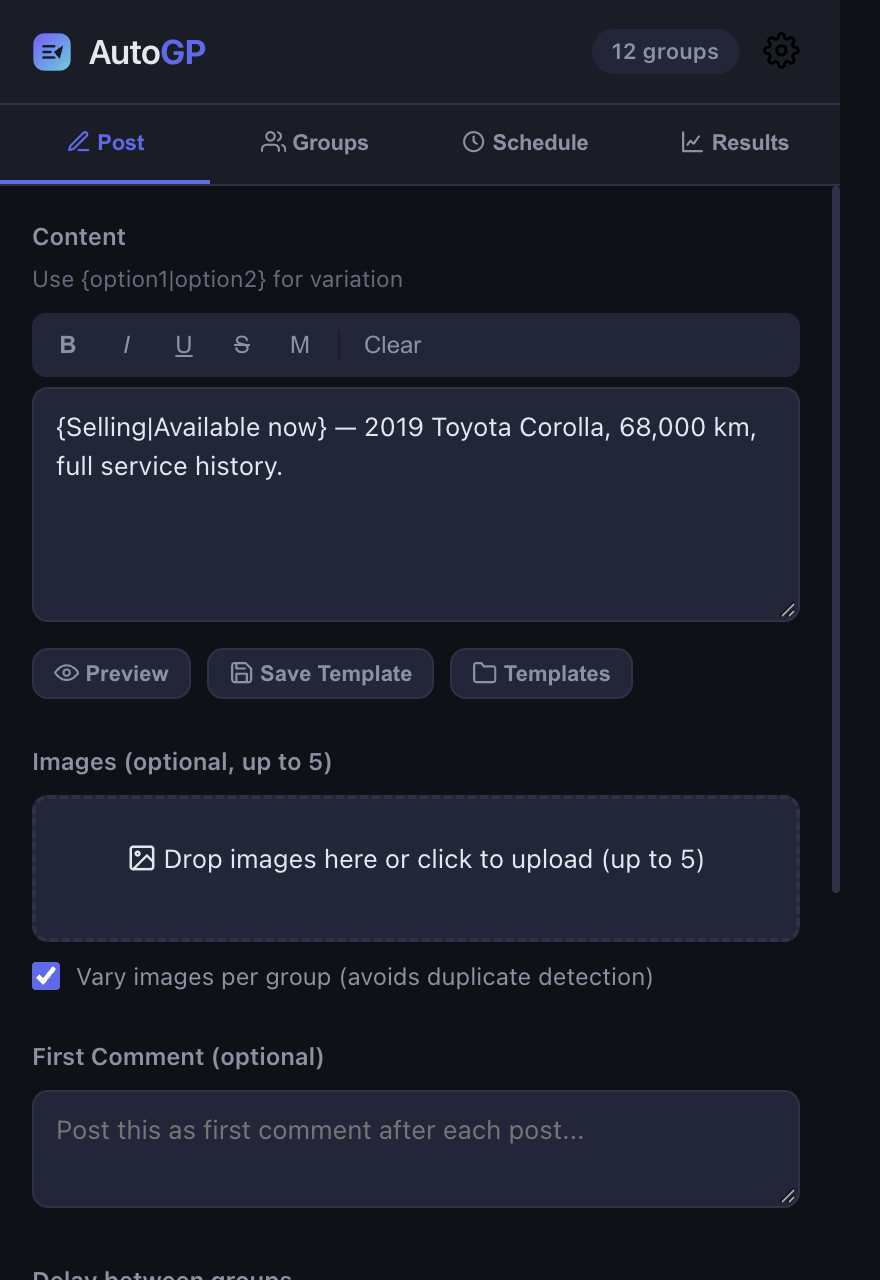
Preview the versions and check the dates and prices.
Schedule it a few weeks before term and repeat it weekly until the places fill.
Check Results for which groups it went up in, and answer parents' questions from there.
Protection is on by default: a warm-up daily limit set by your account's age, random delays, and a guard against near-identical posts. After 19 free posts (no card), see pricing. Any posting tool carries some risk to your Facebook account, which our terms explain.
What not to do
- Children's faces or names without written permission.
- Qualifications or licenses you don't hold.
- Guarantees: "guaranteed A grade", "pass first time".
- Posting in school groups that ban it.
- Your full home address in a public group; share it after a parent gets in touch.
- The same post in every group every day. Once a week per group is plenty; see posting limits.