The short answer: people order food from neighbors they've seen in their town's Facebook groups. A weekly post with real photos, the menu or what's available, prices, the order deadline and how pickup works, in the community, foodie and parents' groups around you, turns into regular orders. The only cost is the evening spent pasting it into every group. AutoGP posts it for you, on the day each group allows, so you can bake.
For other kinds of business, see all our business guides.
Where local food customers gather
- Town and neighborhood community groups, usually with one day a week for business posts.
- Local foodie groups:
[town] foodies,[city] eats,what's for dinner [town]. - Parents' groups:
[town] moms,[school] parents, for birthday cakes, class treats and family meal prep. - Shop-local and small business groups, friendlier to sellers but with fewer buyers.
- Event and wedding groups for caterers, dessert tables and food trucks.
Read each group's rules for business days, whether prices and links are allowed, and whether home food sellers are welcome at all. Some community groups ban home food sales because of complaints; respect it.
How to promote your home bakery
Home bakers post every week, because most sell in batches with a deadline: "orders close Wednesday for Saturday pickup".
- Search Facebook for:
[town] community,[town] moms,[town] foodies,[county] small business,homemade [town]. - What works: your own photos in daylight, the price per item or per dozen, the order deadline, pickup times and place (the neighborhood, not your full address), and the allergens.
- Weekly rhythm: menu post early in the week, a "last call" before the deadline where groups allow a second post, and a "sold out, thank you" comment on the first post.
- Yearly calendar: Valentine's Day, Easter, Mother's Day, graduations, back to school, Halloween, Thanksgiving and the December holidays. Post the holiday menus three to four weeks ahead.
{This week's bake|Baking this Saturday|Saturday's bake}: [item] [price], [item] [price], [item] [price]
{Order by|Orders close} Wednesday 8 pm. Pickup Saturday 10 to 1 in [neighborhood].
{Contains|Allergens}: wheat, eggs, milk. The [item] contains nuts.
[The home kitchen statement your state requires, word for word]
{Message me|Comment below} to order.
The braces only change phrasing. Prices, the deadline, the allergens and the home kitchen statement stay outside them, identical in every group.
How to get more cake orders
Custom cakes sell on your portfolio and your calendar:
- Post one finished cake per week with its size, flavors and the price for that size.
- State the lead time ("two weeks for custom designs").
- Post "open dates for [month]" when dates open up, and "fully booked for [date]" to show demand only when true.
- For wedding cakes, use wedding groups and link the tasting booking in the first comment where allowed.
How to get more catering clients
- Search Facebook for:
[city] wedding planning,[city] brides,[town] events,[city] office managersor[city] HR professionals,[school] PTA. - What works: a menu with a price per head or per tray, minimum order size, what's included (serving, setup, disposables), and photos from a real event with the client's permission.
- Rhythm: every two weeks outside the season, weekly in the months before it.
- Calendar: graduation parties (April to June), office holiday parties (post in October), wedding season (post in winter for spring and summer).
{Catering|Party trays} for [event types] in [area]
[Menu or tray list], from [price] per {person|head}, minimum [number]
{Includes|Comes with}: [setup, serving, disposables]
{Booking|Now booking} [months]. {Message me|Send me a message} with your date and headcount.
How to get more meal prep customers
- Search Facebook for:
[town] fitness,[gym name] members,[town] moms,[hospital or employer] staff,healthy eating [city]. - What works: the week's menu with portions, the price per meal and per week, delivery or pickup days, and the order cutoff. Don't make health claims you can't back up ("helps you lose weight"); describe the food.
- Rhythm: every week, same day, so customers learn when to order.
- Calendar: January, before summer, and back to school are the busiest.
How to promote a food truck
- Search Facebook for:
[town] community,[city] food trucks,[city] events,[brewery name] fans,[office park] employees. - What works: where you'll be, when, and what's on the menu this week. One schedule post a week, a same-day reminder where allowed, and a photo of the day's special.
- Private bookings: a separate post for weddings, office lunches and school events, in the groups where those are planned.
- Calendar: season opening in spring, festival season in summer, and fall events like football and Halloween.
{This week's stops|Where to find us this week}:
Mon [place] [times], Wed [place] [times], Fri [place] [times], Sat [event] [times]
{This week's special|Special}: [dish] [price]
{Book us for your event|Private events}: {message us|send us a message}.
How to get more customers for your restaurant or café
Restaurants and cafés have a storefront, so groups work best for what's new: a menu change, a special night, a local event, a new opening.
- Search Facebook for:
[town] community,[town] foodies,new to [town],[town] events,[neighborhood] neighbors. - What works: one specific reason to come this week (a seasonal dish, trivia night, live music, a new brunch), with the day, time and price. General "come visit us" posts get ignored.
- Rhythm: weekly where groups allow; restaurants that post daily specials should keep those on their own Page and save group posts for the week's highlight.
- Calendar: Valentine's Day, Mother's Day, graduation season, patio opening, holiday party bookings.
The rules for food businesses
- Cottage food laws. Most US states let people sell certain foods made at home, usually shelf-stable ones such as breads, cookies, many cakes, jams and dry mixes, directly to customers. Many exclude foods that need refrigeration, such as cheesecake, custards, cream fillings and meat. Some states require registration, a permit, a food handler course or a yearly sales cap, and most require a label with the ingredients, allergens and a statement that the food was made in a home kitchen. Check your state's cottage food rules, or your local authority outside the US, before posting.
- Allergens. Name the major allergens in every post, not just on the label. In the US, the major food allergens include milk, eggs, fish, shellfish, tree nuts, peanuts, wheat, soybeans and sesame.
- Food trucks, caterers and restaurants need the permits and inspections your city or county requires; group posts don't change that.
- Meta's rules. Its Commerce Policies prohibit alcohol and some other items on Marketplace; don't post alcohol for sale in groups either. Its spam policy covers repetitive content posted at high frequency.
- Your address. Give the pickup neighborhood in posts and the exact address in a private message after the order.
This is general information, not legal advice.
Doing it with AutoGP, step by step
AutoGP is a Chrome extension paired with your autogp.ai account. It posts ordinary posts to groups you've joined, as the Facebook profile logged into Chrome, and never asks for your Facebook password. Chrome stays open while it posts. AutoGP isn't affiliated with Meta.
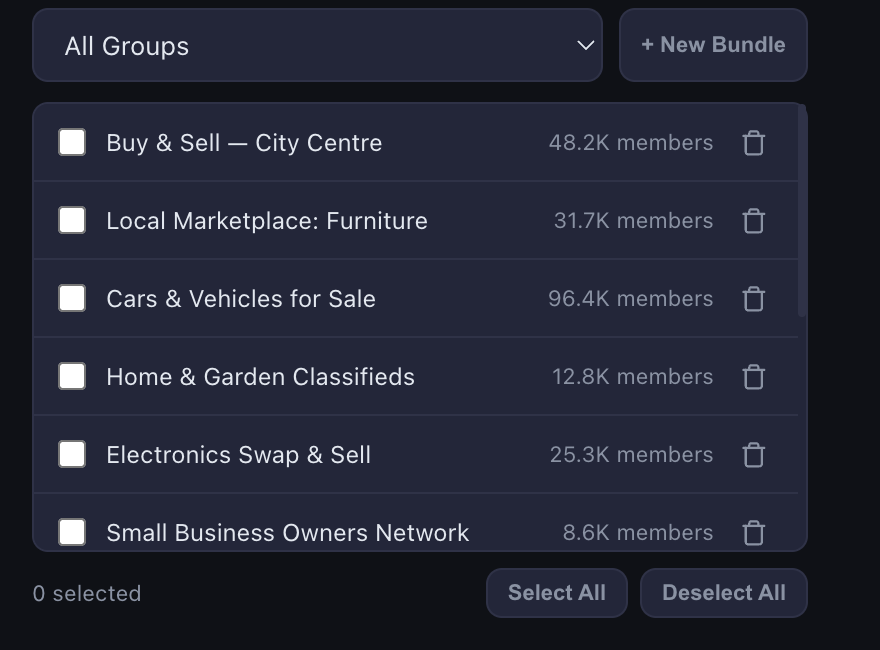
Sync your groups in the Groups tab, then bundle them by business day: "Monday business day", "Foodie groups (any day)", "Parents' groups".
Write this week's menu with the template above and attach up to 10 photos (varied slightly per group). Save it as a template, so next week you only change the items and dates.
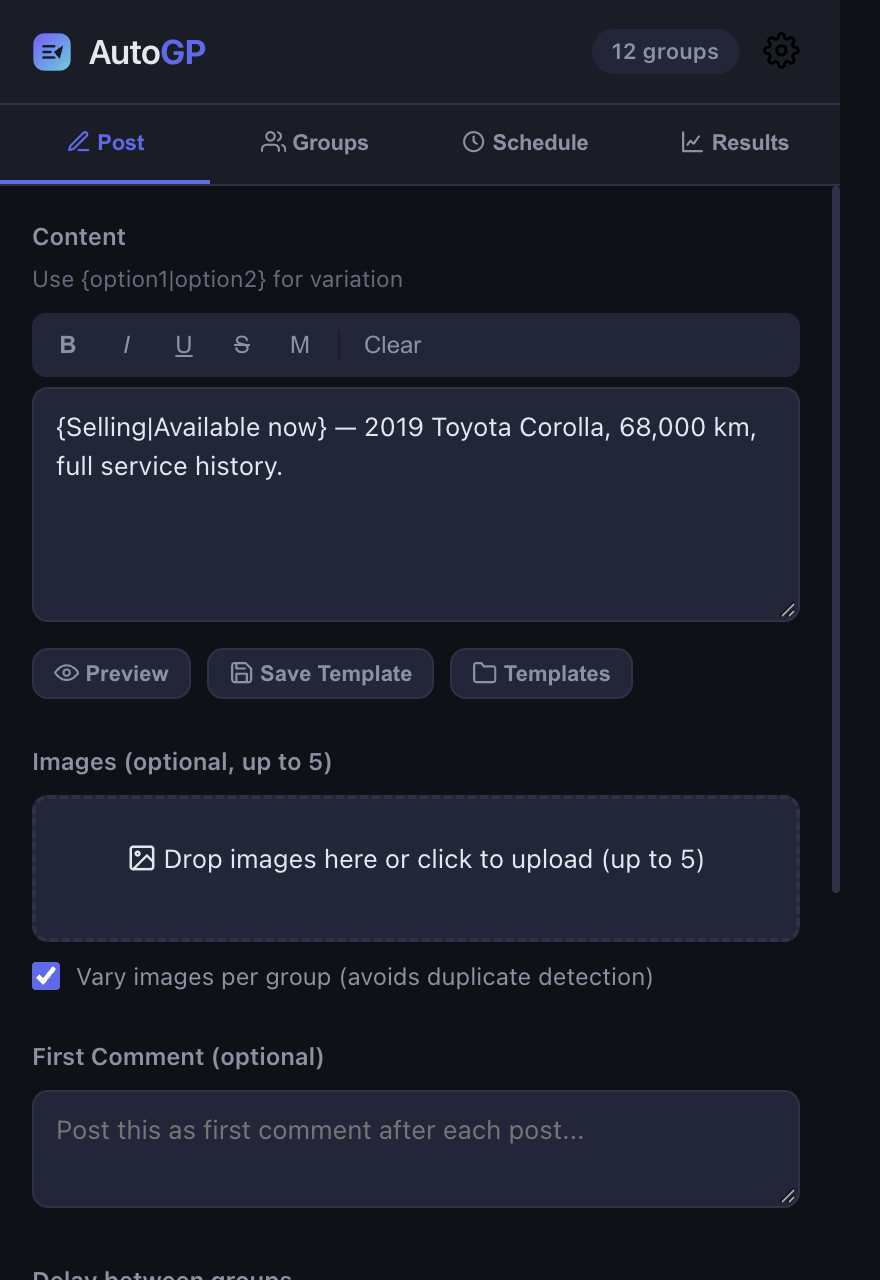
Put the order form link in First Comment where groups allow links.
Preview every version and check the prices, deadline and allergens are identical.
Schedule it in the Schedule tab for each bundle's business day, with Repeat every 168 hours for a weekly menu post you update each week.
Check Results to see which groups took the post, then open them from there to answer order questions.
Protection is on by default: a warm-up daily limit set by your account's age, random delays, and a guard against near-identical posts. After 19 free posts (no card), see pricing. Any posting tool carries some risk to your Facebook account, which our terms explain.
What not to do
- Stock or borrowed photos. Customers order what they see; show your own food.
- Hiding the price. "Message for price" loses most buyers.
- Leaving out allergens or the cottage food statement your state requires.
- Selling foods your cottage food law excludes, like cheesecake or meat pies, without a licensed kitchen.
- Posting your home address in a group.
- The same menu post in every group, every day. Once a week per group, on its day, is plenty. See posting limits.