A lot of local property talk on Facebook happens in groups. Buyers ask about neighborhoods in community groups, renters scan buy, sell and rent groups, newcomers ask for advice in relocation groups, and investors trade notes in landlord groups. A listing there can reach people who haven't started browsing the portals yet.
The catch is that every group sets its own rules, from listings any day to a weekly promotion thread to admin approval for every post. Posting by hand to twenty groups is slow, and identical text in each is the repetition admins decline, members report and Facebook's spam rules target.
Which groups work for real estate
Five types are worth your time:
- Neighborhood and community groups. Reach future sellers and people who pass listings on, but many restrict promotion.
- Buy, sell and rent groups. Built for listings, though some are items-only; see buy and sell group posting.
- Rental groups. Where tenants look for leases and rooms; natural for property managers.
- Relocation and newcomer groups. People researching an area before a move.
- Investor and landlord groups. Better for multi-unit, fixer-upper and off-market deals than starter homes.
Read the rules before your first post
Before posting, check whether:
- Real estate or business posts are allowed at all.
- Listings are limited to a set day or pinned thread.
- Outside links are banned.
- Posts need admin approval. A pending post isn't a failure, so don't post it twice.
- There's a repost limit, such as once a week per property.
Rules change, so recheck them now and then.
Build bundles by area and audience
Save groups that accept listings as bundles:
- By farm area or neighborhood. One bundle per area you work, holding its community, buy/sell and relocation groups, rather than sending every listing everywhere.
- By audience. Buyers, renters and investors, so a duplex reaches investor groups and a lease reaches rental groups.
Audience means what someone wants to do, not who they are. Picking groups by who you'd like as a buyer or tenant runs into the fair housing rules below. If a listing goes into a group built around one community, post it in that area's general groups as well.
A listing post that works in groups
Members read on phones and scroll fast, so keep posts tight:
- A hook. Just listed, where, and the price.
- Three to five key facts. Beds, baths, size, the standout feature, parking.
- One next step. Message you, book a showing or come to the open house.
Photos. Lead with your strongest image, since the first photo does most of the work in a feed. Use a handful of shots, and skip text overlays like price banners, which look like ads.
Links. Some groups remove posts with links in the body. There, invite messages instead, or put the link in the first comment if the rules allow it. AutoGP can add that comment automatically.
Spintax. Options go inside curly braces separated by a pipe, like {Just listed|New listing}, with no set inside another. Only spin phrasing that means the same thing; price, size, features and dates stay identical. Swap the bracketed parts for your details.
A new listing:
{Just listed|New listing|Now on the market} in [neighborhood]: {a|this} [3]-bedroom, [2]-bath home {at|for} [price].

{Highlights|What stands out|Quick facts}:
- [Size] with [standout feature]
- [Parking or outdoor space]
- {About|Around} [10] minutes to [transit, downtown or a main road]

{Interested in a showing?|Want to see it in person?|Would you like to see it in person?} {Send me a message|Message me} for the full details.

[Your name], [brokerage name]
An open house:
{Open house|Open house coming up|You're invited to an open house}: [day], [date], [start time] to [end time]

[Address], [neighborhood]
[3] bed, [2] bath, [size], {listed at|offered at} [price]

{No appointment needed.|Just drop in any time.} {Can't make it?|Busy that day?|Away that day?} {Message me|Send me a message} {to book a private showing.|and I'll find another time.}

[Your name], [brokerage name]
Two versions the first template could produce:
Just listed in [neighborhood]: a 3-bedroom, 2-bath home at $425,000.

Highlights:
- 1,850 sq ft with a fenced backyard
- Two-car garage
- About 10 minutes to the train station

Interested in a showing? Send me a message for the full details.

[Your name], [brokerage name]
Now on the market in [neighborhood]: this 3-bedroom, 2-bath home for $425,000.

What stands out:
- 1,850 sq ft with a fenced backyard
- Two-car garage
- Around 10 minutes to the train station

Would you like to see it in person? Message me for the full details.

[Your name], [brokerage name]
Keep your posts compliant
In the US, the Fair Housing Act, 42 U.S.C. §3604(c), makes it unlawful to publish any notice, statement or advertisement about selling or renting a dwelling that indicates a preference, limitation or discrimination based on race, color, religion, sex, handicap (disability), familial status or national origin. Familial status covers households with children under 18, plus people who are pregnant or securing custody of a child. Treat a group listing post like any other ad; state and local laws can add protected classes.
HUD's regulation, 24 CFR 100.75, applies this to photographs, illustrations and symbols as well as words, and to selecting media or locations for ads in a way that denies particular segments of the housing market information because of a protected characteristic. Where you post matters, not just what you write.
The practical rule: describe the property, not the person you picture living there. These examples draw on HUD's 1995 advertising memo, since taken down without a formal withdrawal notice, and fair housing agency guides:
| Avoid (describes people) | Try (describes the property) |
|---|---|
| Perfect for a young family | Three bedrooms, family room, fenced yard |
| Ideal for singles or a couple | One bedroom, 10 minutes to downtown |
| Adults only, no kids | Quiet street, non-smoking building |
| Religious or ethnic labels, like Christian home | Walk to the park, shops and bus stop |
| No wheelchairs | Fourth-floor walk-up; wheelchair ramp at entry |
Housing that legally qualifies as housing for older persons, like a qualifying 55-plus community, can advertise as such.
HUD's April 2024 guidance on advertising through digital platforms, which focused on ad targeting and delivery, was withdrawn effective September 17, 2025, per a Federal Register notice of April 6, 2026. The notice says actions that don't comply with the Act's text remain subject to enforcement, and the regulation above still applies.
License laws add their own advertising rules. North Carolina's Real Estate Commission requires your firm's name in the social media ad itself, not just your profile, while Texas lets the required information, including the broker's name, sit on your profile or a separate page if it's readily noticeable and reachable by a direct link. REALTOR® members also have Code of Ethics Standard of Practice 12-5 on disclosing the firm name. Check your own state's rules, or your local regulator's outside the US.
This is general information, not legal advice. Your broker can check a phrase you're unsure about.
How often to post
Post when something real happens, not on a timer:
- New listing. The main post, to the area bundle and any matching audience bundle.
- Open house. Around 48 hours ahead gives people time to plan.
- Price change. News to buyers who passed the first time.
- Under contract or sold. A short update where the group allows it. Check MLS and brokerage rules before sharing a sale price.
In between, leave the listing alone: no identical text in the same group and nothing past a group's repost limit.
Daily volume matters too. As a rough guide, newer accounts should post far less than established ones; see realistic daily numbers by account age.
Doing it with AutoGP, step by step
You run AutoGP as a Chrome extension linked to your autogp.ai account. It posts only to groups you've joined, through the Facebook login already active in Chrome, and your Facebook password is never requested or stored. Keep Chrome open while it runs. AutoGP isn't affiliated with Meta. How multi-group posting works covers the rest.
Sync the groups you've joined. The Groups tab loads them all.
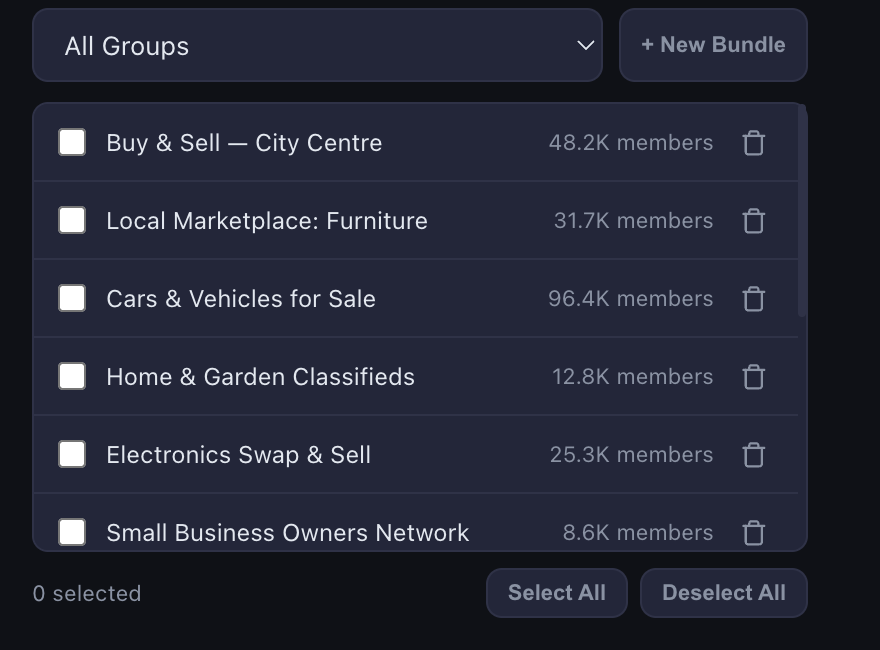
Bundle each farm area. Save an area's community, buy/sell and relocation groups together, plus renter or investor bundles, minus groups that ban listings.
Write the listing with spintax. Paste a template into the Post tab, fill in the details and add photos, which are varied slightly per group. Optionally add the listing link as an automatic first comment, and save it as a template.
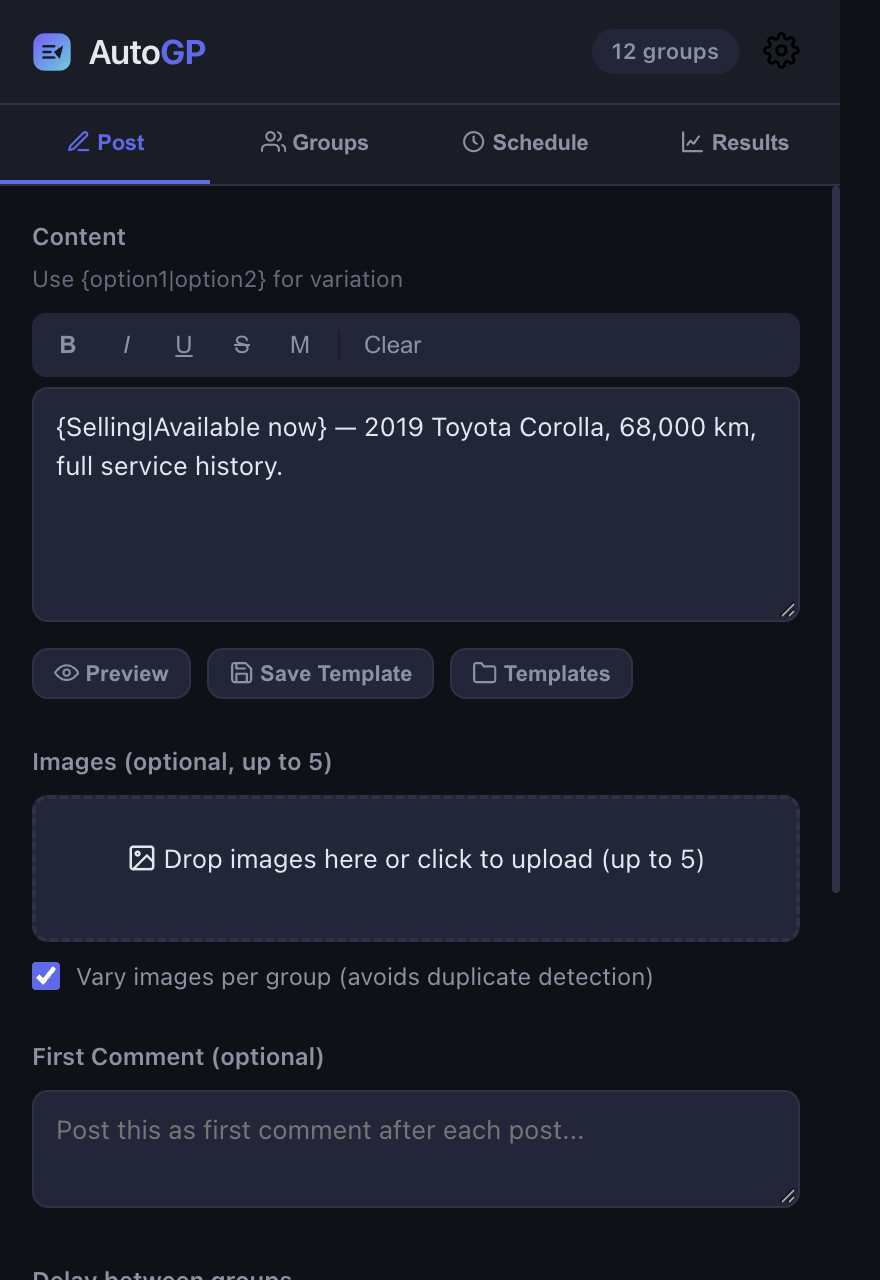
Preview the variations. Fix any version that reads awkwardly or shifts a fact.
Choose a delay and start. Gaps between groups vary at random and lengthen as the day's posts add up, inside a default 08:00 to 23:00 window. The warm-up limit begins at 5 posts a day when an account is under a month old, or 30 once it's over two years, and climbs about 30% a week to an age-based ceiling of 20 to 90, unless you set a manual limit. A duplicate-content guard warns about near-identical recent posts.
Review the run. Post history shows which groups got the listing. Unavailable groups are skipped; an account-level block from Facebook halts the run.
After 9 free posts (one-off, no card), AutoGP costs $27 per month or $197 per year. Any posting tool carries some risk to your Facebook account, which our terms explain.
What not to do
- Posting in groups that ban promotion. Posts get removed or reported, and admins can remove you. If listings belong in a weekly thread, use the thread.
- Identical copy in every group. Meta's spam policy names posting repetitive content as an indicator of spam, and local groups share members who will notice. Vary the wording, never the facts.
- Posting to 50 groups on a brand-new account. A new profile has no history behind that volume, so start with a few posts a day and ramp up gradually.
- Misleading price or availability. Don't advertise a price the seller won't take, a home already under contract, or another unit's photos. Texas's rule, for one, treats an ad inaccurate in any material fact as misleading.
- Reposting sold properties. Once a home is under contract or sold, stop posting the listing and update earlier posts.