If you sell locally on Facebook, your buyers are spread across many groups: your town's buy and sell group, the next town's, a furniture group, a kids' gear group, a cars group. Reaching them means opening every group, pasting the same text, re-attaching photos and checking each group's rules. In busy groups, newer listings soon bury your post, and you start again.
This page covers where Marketplace's own way to post a listing to multiple groups stops, and what works instead.
What "List in more places" does — and where it stops
Open a listing you've published on Marketplace, tap the three-dot menu and choose List in more places. Facebook shows suggested groups, and you add the listing to the ones you want, one group at a time, so it shows in those groups' feeds too (Alphr's walkthrough).
The catch is that it suggests groups rather than listing all of yours. Walkthroughs describe Marketplace choosing them from the brand, style and category on your listing, so a vaguely described item gets few suggestions and some of your groups never appear. That's the likely reason List in more places isn't showing all your groups. Sellers also report the option disappearing altogether, and the menu changes over time.
In practice:
- Fill in category, brand and condition accurately. It gives Marketplace more to match on.
- Treat it as a bonus. Your most important groups, like your town's group, may never be suggested. To get a Marketplace listing into one of those, share it to the group from the listing or post there directly.
Marketplace listing vs a post in a buy and sell group
Both put your item in front of local buyers, but they work differently.
| Marketplace listing | Post in a buy and sell group | |
|---|---|---|
| Where it appears | Marketplace browsing and search, by location | That group's feed |
| Who sees it | Buyers browsing Marketplace near the item | Mainly the group's members |
| Rules | Meta's Commerce Policies and Community Standards | The same Facebook policies, plus the group's own rules |
| Approval | Listings that break the Commerce Policies can be rejected or removed | Admins can require approval before posts appear, and remove posts |
| Format | Set fields such as price, category and condition | An ordinary post, or a sale post with price and location |
| Reposting | You manage and edit one listing | Each group sets its own limits on reposts and bumps |
Some buy and sell groups are built around Facebook's sale-post format, keep ordinary posts in a separate Discussion tab, or may not take them at all, so check a group's rules before adding it to your list. If a group won't take your post, see why you can't post in some Facebook groups.
Rules that apply
Facebook's rules
Facebook's Help Center says items sold on Facebook, in groups as well as on Marketplace, must meet its Commerce Policies, and sellers must follow its Terms of Service and Community Standards too. Breaking the Commerce Policies can get listings rejected or removed, or your access to selling features suspended.
Among other things, the policy prohibits selling:
- Alcohol, tobacco products, drugs, prescription products and drug paraphernalia
- Weapons, ammunition and explosives
- Animals and animal parts
- Medical and healthcare products, and hazardous goods and materials
- Recalled products, stolen goods and used cosmetics
- Certain vehicle parts and accessories
- Adult products, and body parts and fluids
- Digital products and subscriptions, documents, currency and financial instruments, gambling, and jobs
- Items that infringe a third party's rights, and posts with no actual item for sale
Event tickets, gift cards and vouchers, pet adoption matching services, and services are restricted, meaning allowed only in limited cases. The policy changes, so check it before listing anything borderline.
Each group's rules
Groups add their own rules, usually in the About section or a pinned post. Common ones:
- Repost limits: how often an item can be posted or bumped, such as once a day or once a week.
- Price in the post: a real number, not "message for price".
- Location: your town or pickup area; some groups only accept local sellers.
- No links: outside links, including to your own store, are often banned.
- Bumping: commenting on your own post to push it back up may be limited or banned.
- Business posts: some groups ban them or allow them only on set days.
Break them and expect removed posts, then removal from the group; repeated member reports can also affect your account.
A listing post that sells
Buyers message the posts that answer their first questions. Cover these, in order:
- The item: what it is, with brand, model or size where it matters.
- The price: an actual number, and whether it's firm or open to offers.
- The condition: be specific, and name any flaws.
- Location and pickup: area, pickup or delivery, and availability.
- One next step: such as "message me to arrange pickup".
For photos, lead with the whole item in daylight on a plain background, add close-ups of labels, measurements and any damage, use the actual item rather than stock images, and change the lead photo when you repost.
To avoid identical text in every group, write the post once with spintax. In AutoGP, {option one|option two} picks one at random for each group. Keep each set one level deep, with no braces inside braces:
{For sale|Selling}: solid oak dining table and 6 chairs
Price: $250, {firm|no offers}
Condition: {very good|great}, {a few light marks on the top|light marks on the top, see photos}
{Pickup|Local pickup} in Maple Heights, {weekday evenings or Saturday|evenings and weekends}
{Message me to arrange pickup|Send me a message if you'd like to see it first}.
One version it can produce:
For sale: solid oak dining table and 6 chairs
Price: $250, firm
Condition: very good, a few light marks on the top
Pickup in Maple Heights, weekday evenings or Saturday
Message me to arrange pickup.
Another:
Selling: solid oak dining table and 6 chairs
Price: $250, no offers
Condition: great, light marks on the top, see photos
Local pickup in Maple Heights, evenings and weekends
Send me a message if you'd like to see it first.
Vary the wording, never the facts: price, phone numbers and links must be identical in every variation, so keep them outside the braces. Preview a few versions to catch combinations that read badly, and see spintax for Facebook groups for more.
How often to repost
Each group's rules set the ceiling, so read them first. Within them:
- Never repost identical text to the same group. Change the wording and lead photo each time.
- Fix the listing before repeating it. No messages after a couple of rounds more often points to the price, photos or title than to timing.
- Clear it when it sells. Mark it sold or delete the post so buyers stop messaging you.
- Watch your total across all groups. A young account posting one item to dozens of groups in an afternoon doesn't look like normal selling. Facebook group posting limits covers realistic daily numbers by account age.
Who this helps
Resellers and flippers
- Build group lists by category as well as area. A town group and a furniture group nearby reach different buyers.
- One item per post. It's easier to find, and to mark sold, than a clear-out post with twenty things in it.
Car sellers
Vehicles have their own Marketplace listing flow, with fields such as year, make, model and mileage. Dealers face tighter rules: from January 30, 2023, Meta stopped supporting vehicle listings created from a Facebook business Page and pointed dealers toward ads, while private sellers could still list from their own profiles (Jalopnik). If you sell cars as a business, check Meta's current rules and whether each car group accepts dealer posts.
- Lead with the facts buyers filter on: year, make, model, mileage, price and location, in the same order every time, outside any spintax.
- Selling parts? The Commerce Policies prohibit certain vehicle parts and accessories, so check before listing them.
Local shops and makers
- Post the product, not the shop. One item with a price and pickup details fits a buy and sell group; a "visit our store" promo usually doesn't.
- Follow business-post days where a group has them. If you make things, state lead times and whether you take custom orders.
Selling property instead? See AutoGP for real estate agents.
Doing it with AutoGP, step by step
AutoGP is a Chrome extension paired with an autogp.ai account. It posts to groups you already belong to through your own logged-in Chrome session, as ordinary group posts, not Marketplace listings. It never asks for or stores your Facebook password, and Chrome must stay open while it posts. AutoGP isn't affiliated with Meta. After 9 free posts it's $27 a month or $197 a year (pricing). The general workflow is on posting to multiple Facebook groups.
Sync your groups. In the Groups tab, click Sync Groups to load the groups you're a member of.
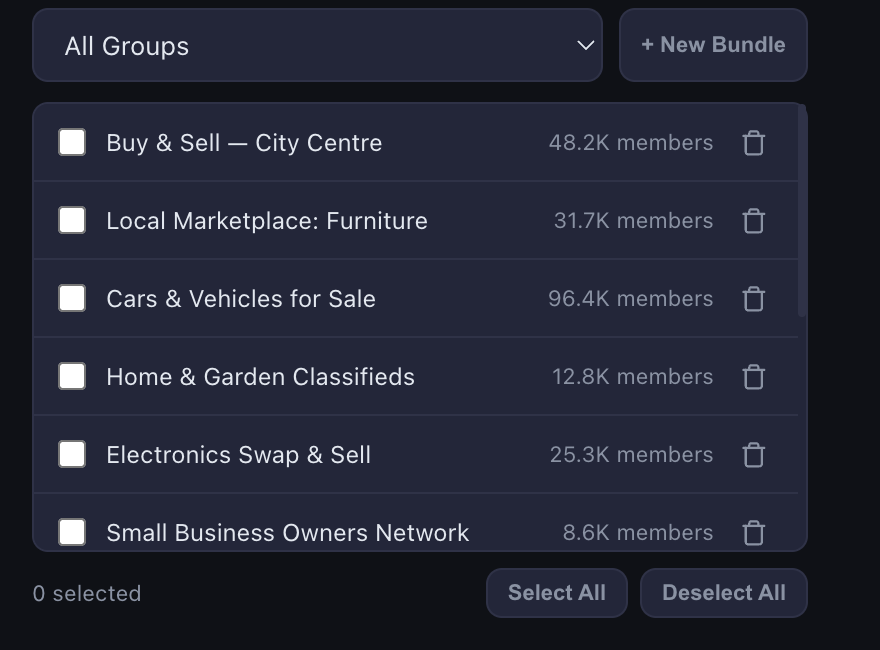
Make bundles by area. Save each town's or region's groups as a bundle, such as "North side", so next time you just pick it.
Write the listing with spintax. In the Post tab, paste your template and add photos; AutoGP varies each image slightly per group. Add an optional first comment, such as pickup times, and save the post as a template.
Preview. Click Preview and check each sample reads well, with identical price, phone number and links.
Set the delay and start. Set the delay between groups, choose your bundle under Post to and click Start Posting. Delays are randomized and stretch as the day's post count grows, inside an 08:00 to 23:00 window by default. Your daily limit starts at 5 posts for accounts under a month old and 30 for accounts over two years, then rises about 30% a week to a ceiling set by account age; you can set your own limit instead. A duplicate-content guard watches for repeats.
Check the results. The Results tab shows which groups the listing reached, which attempts didn't go through, and your posting history. Unavailable groups are skipped, but if Facebook blocks the account itself, AutoGP stops the run.