If you hire for hourly, trade or local roles, job boards only reach part of the people you want. Plenty of the rest are in Facebook groups: local job groups, trade and industry groups, and community groups where someone always knows someone who's looking.
The hard part isn't finding groups. It's the arithmetic of how to post a job in multiple Facebook groups without flooding them: five open roles across forty groups is two hundred posts before any refresh, many groups only take jobs in a weekly thread, and one ad pasted everywhere reads as spam.
What happened to Facebook Jobs, and why groups still matter
Meta began winding down Jobs on Facebook in February 2022, switching it off outside the US and Canada and retiring the "Jobs" group type, so existing job groups became "General" groups. It then shut down completely in the US and Canada by February 22, 2023.
In October 2025, Meta brought local job listings back in the US: a jobs tab in Marketplace, with listings also shown in Groups and Pages, aimed at entry-level, trade and service work. If you hire for those roles in the US, use it alongside groups.
Recruiting on Facebook groups still reaches people a listing doesn't: members joined for job posts in their area or trade, and they tag friends who'd fit. For other roles, and anywhere outside the US, groups and Pages are the main free options.
Which groups to use
Facebook groups for jobs come in three useful kinds:
- Local job groups. Area-based groups for work nearby, and your core for any role where the commute matters.
- Trade and industry groups. Drivers, electricians, dental teams, bookkeepers. Members have the experience but may be spread out, so check each group's location focus.
- Community and alumni groups. Neighborhood, parent, newcomer and alumni groups. Many ban job posts; where they don't, keep yours short and friendly.
Before you post a job to Facebook groups, read each group's rules and pinned posts for:
- Where and how often. Many only take jobs in a weekly hiring thread or on a set day, and some cap posts per member.
- Who can post. Some accept employers but not agencies, or want the employer named.
- Approval and format. Some hold posts for admin approval, require pay in the post or ban links.
If a group won't let you post at all, these are the usual reasons.
Sort the groups that pass into lists by location and by role family (warehouse and driving, office and admin, healthcare). A forklift role goes to that area's list plus the warehouse list, not every group you've joined.
A job post candidates actually answer
People in job groups screen for three things: what the job is, where it is and what it pays. Lead with those:
- Role, employer and area in the first line.
- Pay and schedule. A real range, the hours and the contract type. Leave pay out and the comments fill with "how much?"
- Three requirements. The must-haves, not a wish list.
- How to apply. One clear step, and what happens next.
Here's a spintax template for a warehouse role. Options in curly braces, like {Now hiring|Hiring now}, are picked at random per group. Don't put one set inside another. Replace the bracketed placeholders before posting.
{Now hiring|We're hiring now|We're recruiting now}: Warehouse Associate at [Company], [Area]

Pay: $19–$22/hour, paid weekly
Schedule: Monday to Friday, 6:00am–2:30pm, full-time

{What you need|Must-haves}:
- {Available for|Able to work} the full 6:00am–2:30pm shift
- {Able to lift|Comfortable lifting} up to 50 lb
- Safety boots {from day one|for your first shift} ({we pay for them|we cover the cost})

{To apply|How to apply}: {fill in|complete} the short form at [apply link]. {We reply to every applicant|Every applicant hears back} within 3 working days.
Two of the posts it can produce:
Now hiring: Warehouse Associate at [Company], [Area]

Pay: $19–$22/hour, paid weekly
Schedule: Monday to Friday, 6:00am–2:30pm, full-time

What you need:
- Available for the full 6:00am–2:30pm shift
- Able to lift up to 50 lb
- Safety boots from day one (we pay for them)

To apply: fill in the short form at [apply link]. We reply to every applicant within 3 working days.
We're recruiting now: Warehouse Associate at [Company], [Area]

Pay: $19–$22/hour, paid weekly
Schedule: Monday to Friday, 6:00am–2:30pm, full-time

Must-haves:
- Able to work the full 6:00am–2:30pm shift
- Comfortable lifting up to 50 lb
- Safety boots for your first shift (we cover the cost)

How to apply: complete the short form at [apply link]. Every applicant hears back within 3 working days.
And one for an office role:
{Office Administrator|Office Admin}, full-time, at [Company], [Area]

Salary: $45,000–$52,000 a year
Hours: Monday to Friday, 8:30am–5:00pm, on site

{What you need|What we're looking for}:
- {1+ year|At least a year} in an office, reception or customer service role
- {Comfortable|Confident} with email, calendars and spreadsheets
- {A calm, friendly phone manner|Calm and friendly on the phone}

{Apply|Send your application} here: [apply link]. {No cover letter needed|You don't need a cover letter}.
Keep the facts outside the braces. Pay, location, schedule, contact details and links must be identical in every variation. A candidate who sees $19 in one group and $21 in another trusts neither post. More in the spintax guide.
Keep job ads fair and compliant
A group job post is still a job ad.
Describe the job, not the person. In the US, the EEOC says it's illegal to publish a job ad that shows a preference for, or discourages, applicants because of race, color, religion, sex (including pregnancy, sexual orientation and transgender status), national origin, age (40 or older), disability or genetic information. Its examples include asking for "females" or "recent college graduates." Other countries have their own equal-treatment rules. Write the requirement, such as "able to lift 50 lb," not the person you picture.
Check pay-transparency rules where you hire. Several US states and some Canadian provinces require a pay range in job postings, and EU pay transparency rules, now taking effect, require employers to give applicants the starting pay or range in the vacancy notice or before the interview. Some rules reject open-ended figures like "up to $30 per hour," and some require you to say whether the vacancy exists or whether AI screens applicants. Hiring in several places? Meet the strictest rule.
Be honest about who's hiring. Name the employer, or say you're an agency recruiting for a client. The FTC's job scam advice tells job seekers that honest employers never ask them to pay to get a job, and to look a company up before applying. A post with no company name gives them nothing to look up.
This is general information, not legal advice.
Cadence and volume
A simple rhythm for each role:
- New role. Post to the area and role-family lists.
- Three to five days later. Refresh the wording, keep the facts, and lead with anything real that changed, such as a second shift.
- Closing soon. One last post with the actual closing date, if there is one.
- Filled. Edit the post or comment that the role is filled.
Three habits help:
- Respect weekly threads. Where a group wants jobs in its hiring thread, post there each week, not in the feed.
- Combine related roles. Three warehouse openings in one area are one post, not three posts in the same group.
- Let account age set your volume. A few-weeks-old profile shouldn't post like one with years of normal activity, and sudden jumps are a risk at any age. Build up over weeks, as covered in Facebook group posting limits.
Doing it with AutoGP, step by step
AutoGP is a Chrome extension paired with an autogp.ai account. It posts to groups you already belong to through your own logged-in Chrome session, never asks for or stores your Facebook password, and needs Chrome open while it posts. It isn't affiliated with Meta. You get 9 free posts (one-off, no card), then it's $27 a month or $197 a year (pricing).
Sync your groups. AutoGP loads the groups your account belongs to.
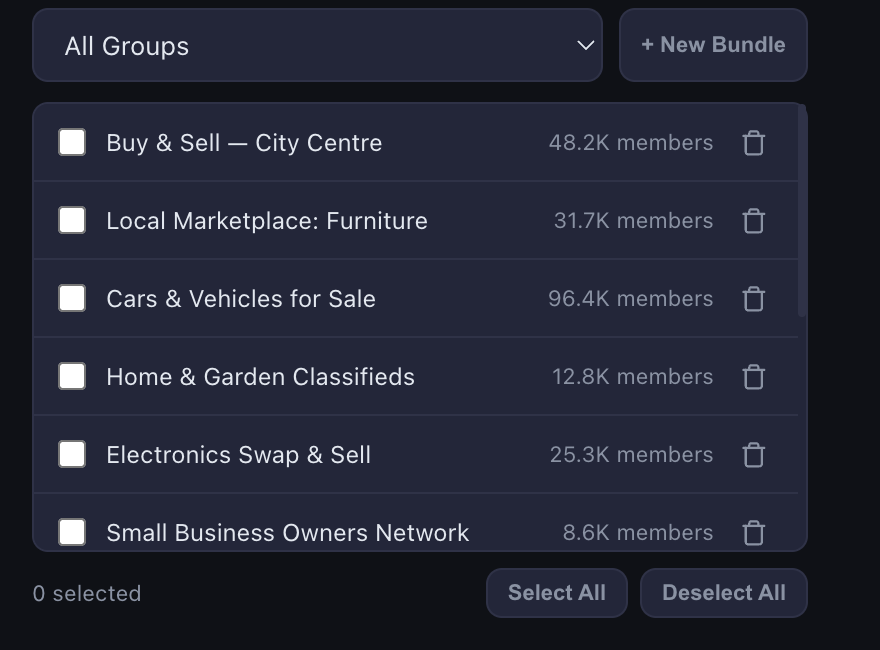
Build bundles by location and role family. Save your lists as bundles and leave weekly-thread groups out.
Write the job post with spintax. Save it as a template for that role family. Photos are varied slightly per group, and the duplicate-content guard warns you when a post is too close to a recent one.
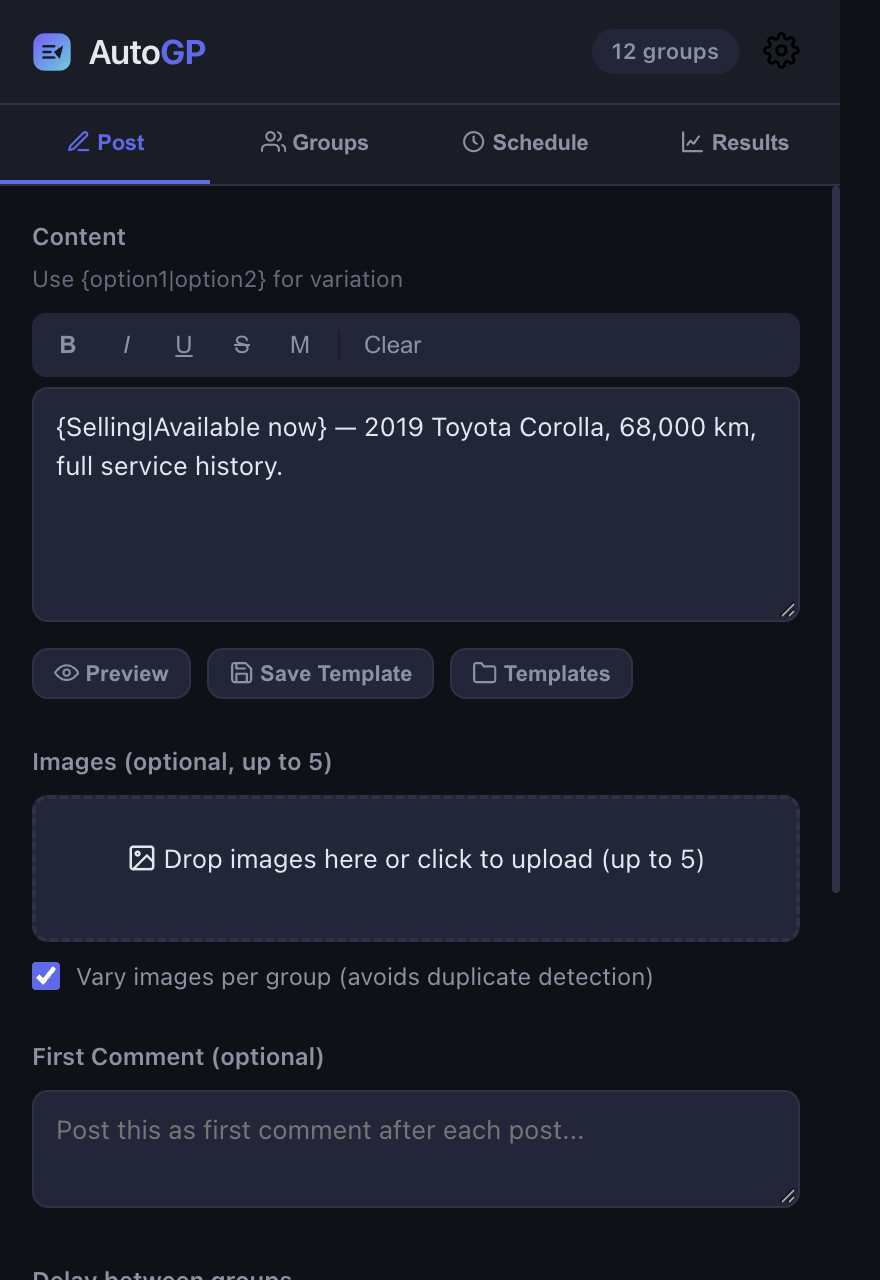
Add the apply link as a first comment, if you like. AutoGP can post it automatically; just say in the post where the link is.
Set your delay and start. Delays are randomized and stretch as the day's count grows. The daily limit starts at around 5 posts for accounts under a month old and around 30 for accounts over two years, adjusted for group posting history, then rises about 30% a week to a ceiling of 20 to 90 a day. You can set a manual limit instead. By default, posting runs from 08:00 to 23:00.
Check the results. Post history shows what went out where. Unavailable groups are skipped, and an account-level block stops the run.
What not to do
- The same text in 60 groups in an hour. Members scroll past it, admins remove it, and it's the pattern spam detection looks for.
- Posting to the feed when a group wants a thread. The post gets removed, and repeat offenders can lose their membership.
- Misleading pay. "Up to $30 an hour" when the base is $18, or weekly earnings that assume overtime nobody gets. Candidates find out at interview.
- "DM me" with no details. Your inbox fills with "what's the job?" and careful candidates skip a post that looks like a scam.
- Collecting sensitive details in comments or DMs. Don't ask for ID numbers, bank details or document photos before a real application.